Arches Sunset

Arches Sunset

Tuesday, 3 September 2013

Northern New Mexico

Over the last two weeks, I have settled down at UNM (despite the daily near-death experiences when rogue cyclists and skateboarders whizz past too close for comfort) and become accustomed to my classes and US life in general. There are many things I notice that are very different to the UK even in terms of general mannerisms, such as the use of the friendly-but-insincere greeting 'Hi, how are you?' which is always reciprocated with 'good, how are you?' I prefer to try and sound a little more genuine and use adjectives than go beyond just 'good'. There have been certain other cultural quirks, such as the frequent muddling of the words 'English' and 'British' (I would love to witness the reaction of a Welshman, Scotsman or Northern Irishman when told in no uncertain terms that they are English!) On the subject of Britishness, one of my teachers has advised me to explain away my foreign accent when interacting with locals by suggesting that I come from Moriarty (a small town about thirty miles east of Albuquerque!) Perhaps one of the strangest examples of a cultural mishap was my discovery that the table football set contained no fewer than thirteen players, prompting my suggestion that it had to be based on rugby league, since no other sport to my knowledge has that number of competitors!

The bizarre twenty-six man table football
(photo: A. Khoja)

The cultural gulf between the UK and the USA was nowhere more apparent than at the baseball match I attended with my friends last week. We watched the Albuquerque Isotopes (named after the team from Springfield in 'The Simpsons' as a result of a 2002 competition) play the Texan team Round Rock Express in the Pacific Coast League, one tier below Major League Baseball. The national anthem was played before the game started, at which point everything in the stadium stopped for two minutes while the anthem was sung, before the entire crowd burst into cheering and applause - not something I had ever encountered before following the playing of 'God Save the Queen'. The between-innings entertainment was a madcap assortment of random activities (largely involving spectators dressed as burritos), whilst the actual match itself was somewhat lacking in excitement. Only two runs were scored during the ten innings, forcing the match into overtime, during which the Isotopes were able to smuggle a player round to take a 2-1 victory. The most important lesson learned was never to buy tickets to watch the Isotopes play, because there were hordes of people giving away unwanted tickets to fortunate visitors. Unfortunately the chance will not come again because the baseball season has now ended, restarting in April, which was one of the reasons for going when we did!

International crowd with famous Isotopes fan Homer Simpson

Isotopes (in black) batting

Victory celebrations for the home side

The following weekend coincided with the Labor Day holiday, equivalent to May Day in the UK. This meant that the Global Education Office organised a three-day trip to the north of the state, which presented a fantastic opportunity to escape Albuquerque and do some exploring!

The first stop was the state capital, Santa Fe, widely acknowledged as a significant arts centre, not just within the state, but within the entire country too. Here, I had the chance to walk around the state capitol building, and then the group moved on to the San Miguel Mission, which dates to the early 17th century and is the oldest church in the USA. This was an intriguing blend of traditional American and colonial Spanish, as it featured adobe architecture and was built atop a native kiva (a form of religious building), but also incorporated an altar screen featuring figures ranging from Christ and the Virgin Mary to King Louis IX of France.

San Miguel Mission, oldest church in the USA

Image of the crucifixion on a cow hide

Interior of the tiny church

We were then able to wander around the city, including the extensive market in the centre, as well as visit the New Mexico History Museum, which featured exhibits on everything from pre-conquest native history to the age of nuclear testing in the 1950s and contemporary New Mexico. The Santa Fe market outside in the plaza was a vibrant and colourful display of all things native and New Mexican, selling everything from locally produced art and traditional bead necklaces to an assortment of spicy southwestern foods. The next stop after leaving Santa Fe was a lay-by where the coach gave us ten minutes to admire the view from the highway across to the impressive Rio Grande Gorge in the distance. From there it was on to the town of Taos, in which we briefly entered the Harwood Museum of Art to admire more paintings, both traditional and modern, that represented the southwestern art movement.

Chillies drying in the Santa Fe plaza

View across State Road 68 to the Rio Grande Gorge

My friend Achraf gets to grips with local art in Taos

The day ended at the superbly named Abominable Snowmansion in Arroyo Seco ('dry creek'), just north of Taos. This was to be our accommodation for the weekend, and after unpacking and getting settled, I realised that in addition to the internal bunk beds were three teepees to the back of the building. Not wishing to miss out on the opportunity to sleep in the traditional style*, I immediately upped sticks and relocated myself to a bed in a teepee! The evening was spent in true cub scout fashion, melting marshmallows over a campfire, before I settled down to sleep in the teepee.

*Teepees are traditional native dwellings, but were used by the Plains Indians (such as the Lakota, Cheyenne and Sioux) living in the Midwest. The natives of New Mexico (such as the Pueblo, Navajo and Apache) never used teepees, instead residing in mud brick dwellings.

My teepee, with a wigwam in the background

I awoke at 0515 and suddenly realised I was cold. I never normally sleep soundly in tents, but the teepee and my bed's many blankets kept me thoroughly snug all night until the moment I rose from my slumber. Outside, the moon was still visible, but once inside the hostel, there was an atmosphere of hustle and bustle, making porridge for breakfast and sandwiches for lunch, and preparing to leave for the mountains. Everyone on the trip was to go on a hike in the Taos ski valley area, but the majority were still asleep as I was one of a group of eight heading off early so as to make the summit of Wheeler Peak, New Mexico's highest mountain and the USA's 99th. When everyone was ready, we drove to the Taos ski base and then set off on the eight-mile ascent of the mountain at 0700.

Early morning light over the mountains

A rather bold bighorn sheep

Group of bighorn sheep looking down to the group

Along the way, we encountered a handful of fellow early-morning risers, and within a short time had cleared the tree line. Once above the tree line, the landscape was uncannily reminiscent of the Scottish highlands, although the frequent barks from the local marmots indicated that it was a far cry from the Caledonian hills. The largest animals we saw were bighorn sheep, who were relatively unperturbed by our presence, and one individual came within twenty or thirty metres of the group during a food break! Time flew as we continued the climb, and at 1100, we reached the small cairn and large group of climbers that marked the 4,013 metre summit of Wheeler Peak. This vantage point offered spectacular vistas of the mountainous landscape, and here we enjoyed a very well-earned lunch on top of New Mexico, and 650 metres above Williams Lake, the eventual destination of all the others in the main group!

Horseshoe Lake seen from the ridge close to the summit

The final approach to Wheeler Peak

The eight intrepid explorers at the summit!

The UK's summit representative!

The view east from Wheeler Peak

After an hour-long break at the peak, it was time to make the journey down the west face of the mountain towards Williams Lake. I could well have spent a day camped out on the summit, partly because it was the first time to my knowledge that I have climbed to over 3,000 metres, but also because Wheeler Peak is significantly higher (three times) than the UK's highest mountain, Ben Nevis. However, time was of the essence because of the risk of lightning strikes on the summit, forcing us to beat a hasty retreat to the safety of the tree line. The first section of the descent was a tricky slope covered in gravel and small rocks, which then gave way to a smoother path, where we found ourselves once again in the company of marmots!

Yellow-bellied marmots

Williams Lake, seen from the side of Wheeler Peak
Williams Lake

Reflections on the lake

Once we reached Williams Lake, we came across some members of the larger group, for whom Williams Lake had represented the high point of their walk. Here we enjoyed a leisurely break, and we headed off downhill before the rain that had been threatening began to fall. The final break was a couple of miles further on, at the Bavarian Inn, which surprisingly did remind me of southern Germany, particularly in its pine forest setting. On the last couple of miles to the ski valley from the Bavarian, the rain at last caught up with us, and we did get wet, but by that late stage, it could do nothing to dampen the group's spirits, and we soon warmed up and dried off back at the hostel.

The second night in the teepee was every bit as comfortable as the first, although this time there was no need to get up at such an uncivilised hour! After a relaxed breakfast, we cleared the hostel and journeyed to the Rio Grande Gorge Bridge, from which we were able to admire the breathtaking 172-metre drop to the river below. We then went on to the Taos Earthship, a sustainable home project, where we were briefed on house construction and management techniques that limited the exhaustion of natural resources. Of particular relevance were the earth berm systems used in the houses to maintain constant cool temperatures during the hot summers and cold winters, and the water system, owing to the need to conserve water in a desert environment.

The majestic Rio Grande Gorge

Route 64 on the Rio Grande Gorge Bridge

The beautiful and aptly-named Rio Grande Gorge Bridge

Taos Earthship - sustainable home

Irresistible shot stereotyping the desert West

Following the Earthship, we travelled to the Taos Pueblo, one of the 21 remaining Native American pueblos. This was of special relevance because I have been studying the pueblo people as part of a unit on the history of New Mexico, and in particular how the Pueblos were treated differently compared to other native groups, such as the Navajo. The Taos Pueblo is a UNESCO World Heritage Site and features distinctive adobe buildings, whilst the 150 or so residents still practise various native crafts. The Taos Pueblo is known for being one of the more conservative and secretive pueblos, and running water and electricity are not available there. The people have strict rules regarding photography so anybody intending to take photos had to pay $6 for a permit and even then one had to be selective about what was being photographed so as not to cause offence. Our guide toured us through the main areas of the Pueblo and even taught us a couple of basic phrases in the indigenous Tiwa language (one of five spoken in the New Mexican Pueblos, the others being Tewa, Towa, Kiowa and Zuni). Tiwa is a tonal language, so even after a couple of attempts at repeating the phrase 'hello' ('yo-oh'), I was fairly sure I had already desecrated the Tiwa tongue!

The traditional buildings and distinct, conservative atmosphere left a lingering impression; aside from the villagers' modern clothing, I would not have been surprised to have come across the same scene 100, 200 or 500 years ago. The arrival of Europeans to the Southwest from the 16th century onwards clearly affected the Pueblo's history significantly, but in many regards their ancient lifestyle has been resistant to change. The Pueblo survives as a fitting relic to the thousands of other indigenous cultures that once covered all of North America, and many of which have already disappeared forever.

The North House, the largest building in the Pueblo
The square in front is used for ceremonial dances
Taken from the bank of the Red Willow Creek,
the Pueblo's main water source
(photo: C. Takahashi)

San Geronimo Church and the Pueblo's cemetery
The church was destroyed by US soldiers during an 1847 rebellion
The gravestones reflect the mainly Catholic population of the Pueblo
(photo: C. Takahashi)

Before returning to Albuquerque, we stopped for lunch beside the Rio Grande, which meant there was an option to have a swim in one of the world's most famous rivers; I was hardly going to say no! Indeed, I was the first member of our group to immerse myself in the cool waters of the river, and had a great time riding the current downstream and relaxing in the slower sections. So, with this intensely refreshing feeling still lingering, it was time to return to UNM and prepare for the week's upcoming classes...

Our swimming spot - the Rio Grande near Dixon

Taking time out of the water to bask on the red-hot rocks!
(photo: M. Mamytova)

Monday, 19 August 2013

International Orientation

I have now been at the University of New Mexico for almost a week, although it feels like it has been far longer! There has been so much going on that the honeymoon period is already over and classes have now started. However, the fact that it was so fleeting has not diminished my orientation experience at all!

The first full day here, a Wednesday, involved sorting out loads of forms and documents, but once the boring stuff was over, the fun began! That evening involved eating 'S'mores', an American treat consisting of an oversize marshmallow sandwiched between some biscuits, with chocolate to boot. Hardly a healthy start to my stay in New Mexico! Here I met my first few international students, and had the opportunity to exhibit my semi-legendary table tennis skills against both international and local students. Compared with Virginia, New Mexico appears to be much less exposed to European visitors, as within the first twenty-four hours, my southern English accent was mistaken for both Australian and German, and I was once asked whether my accent was 'real', much to my amusement.

Old Town Albuquerque

On the Thursday, all the internationals gathered for a trip into Albuquerque, which was my first proper opportunity to see the city. Here I met a multitude of people from all over the world, making a marked difference from the familiar assortment of foreigners I am used to in the UK, consisting mostly of Europeans, Indians and East Asians. I quickly made friends with two boys from Japan, an Azerbaijani, a Colombian and a Bolivian, and soon afterwards I met a Tunisian, an Indian and a Kyrgyzstani too. Several of us played football in a city park for a while, although we soon found that running after a ball was significantly hotter than just standing in the sun! (N.B. For purposes of clarity, I use the word 'football' in place of 'soccer' on the grounds that it is the term used almost everywhere in the world apart from the USA).

We also took the time to explore the Museum of Art and History, much of which contained interesting and thought-provoking depictions of New Mexico and the American West, although I am not much of an art buff, and the modern section was definitely less inspiring. On the other hand, the Explora! Science Centre was a lot of fun - several of us spent time playing with an impressive marble run and an interactive fountain, and I had the chance to ride a bicycle backwards across a tightrope - something I have never done before and doubt I will again!

Riding a bicycle backwards across a tightrope

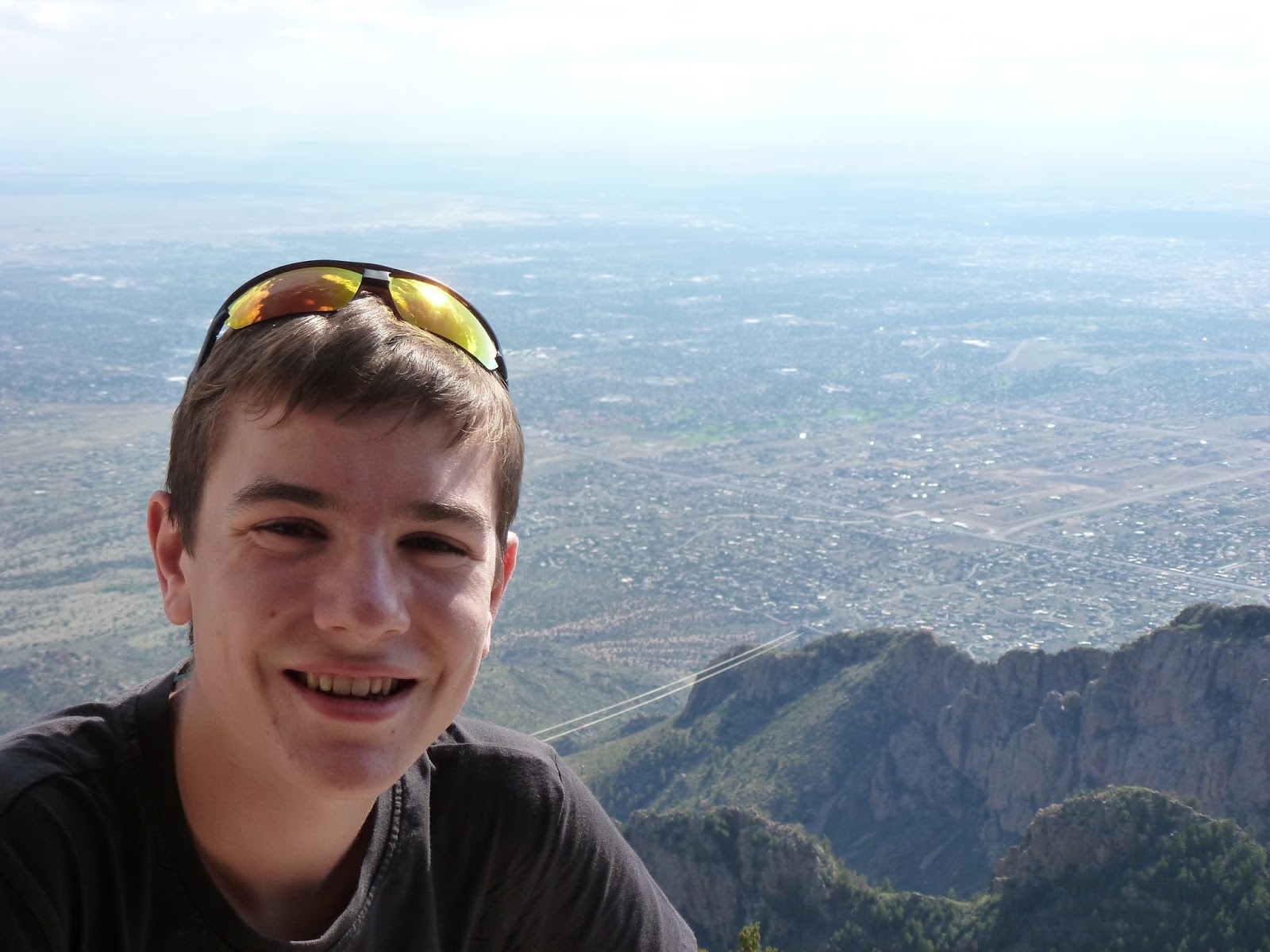
My new friends and I went to the gym in the evening, where a variety of activities were on offer for free, including dodgeball and climbing. The following morning provided less spectacular activities, as it was mostly talks and paperwork again, but the afternoon more than made up for it. Albuquerque is situated beside the Sandia mountains, which rise 1,500 metres above the city, making for an impressive backdrop. The university had arranged a trip up to the top in the cable car. This was a noteworthy journey in itself because the Sandia Peak Tramway boasts of being 'the world's longest aerial tramway'; it is 2.7 miles long with a 1.5 mile single span, and at one point it is 300 metres off the ground. Needless to say, the view from the top was breathtaking, as I could see Albuquerque in its entirety, with the Rio Grande snaking across the landscape and distant peaks and mesas up to fifty miles away. A clear view from the summit can include 11,000 square miles of the New Mexican landscape, so it was definitely an experience that will be hard to forget.

On the 1.5 mile single span of the tramway

Albuquerque from the summit of Sandia Peak

Colorado Chipmunk

On the smaller scale, the summit also provided me with a sight of my first ever chipmunk, so that was another cause for excitement. I went on to spot two more, as the group went on a short hike from the cable car to a mountain cabin further along the ridge. My hopes of seeing a wolf or bear were unrealised, although an encounter with an aggressive bear might have slightly spoiled my day! All too soon, it was time to leave the mountain and we returned to the cable car for the fifteen minute ride back to the base.

Overlooking the city

View south along the Sandia ridge

On top of the world with Achraf, from Tunisia

The Sandia mountains are named after the Spanish word for watermelon, owing to the reddish colour they give off at sunset. Unfortunately, I was unable to witness this because the evening provided further entertainment, as it entailed 'Friday Night Live', a sort of elaborate freshers' fair. This meant I had plenty of free food and a wander around stands advertising every imaginable club or society. Towards the end, a couple of friends and I queued up to play a game of laser tag, which was on offer for some reason! In the hour or so we spent waiting to play, we were able to get to know a few Americans in addition to the many internationals we had already befriended.

The arrival of the weekend did not put an end to the activities, as there was an extensive international picnic on campus, allowing even more opportunity to socialise with a mixture of people from all over the world. At the picnic, a group of us made a plan to play a football match that evening, and this saw, by my reckoning, twelve of the most average footballers from nine countries compete for nothing more than pride over the space of about two hours! The high altitude (Albuquerque is at 1,600 metres) and a general lack of fitness made breathing difficult and it was certainly a challenge to keep chasing after the ball. We eventually finished once it became too dark to see the ball, with the final score 17-9: Bangladesh, Germany, India, Tunisia, the UK and the USA triumphed over Azerbaijan, Japan (x2), South Korea and the USA (x2).

A corner is taken during the thrilling match


The Sandia mountains provide an awesome backdrop to the game

A certain British player is undone by the altitude

Wednesday, 14 August 2013

The First Week: Washington DC


Yesterday I arrived in Albuquerque, New Mexico, to begin a four month university placement. The opportunity to spend some time abroad arose soon after I started at the University of Exeter last year, and now that all the organisation has been taken care of, my placement is beginning in earnest!

I flew in to Albuquerque from Washington DC, which involved a four hour stop in Denver but was actually a very pleasant journey, and I even managed to glimpse the Mississippi River when the clouds had subsided. Prior to this flight, I had spent a week in Virginia with my friend Jonathan, which meant that I was able to visit Washington DC and explore some of the eastern USA before heading to the western half of the country.

My first ever sight of North America - Quebec and the Gulf of St Lawrence

I travelled from Heathrow to Dulles airport, which was a comfortable trip and quite interesting once I reached North America, as I saw parts of Canada and New England, and briefly spotted New York City to the east. The queue for immigration at Dulles was huge, taking ninety minutes to get through. The problem was mostly the result of the airport having over a dozen desks, but only one employee stamping passports; I thought that perhaps he was so good at his job that the airport didn't trust anybody else to work there!

When at last I got through immigration and security, I was met by Jonathan and his wonderful family and was extremely well looked after from that point on. Jonathan is an American, but he lived in the UK for three years, so he and his family were able to gently break me in to the American lifestyle. I had a brief freshen up at his house, after which I was whisked off to visit George Mason University, which Jonathan had attended the previous year, so my American sightseeing began very early on.

Washington Monument and Reflecting Pool

On my second day, we headed into DC itself, beginning at the Lincoln Memorial, and working our way along the National Mall towards the Capitol at the other end. Having seen most of the major monuments on the Mall, we entered the Natural History Museum, which housed a host of stuffed animal exhibits, fossils, and live specimens of various insects and fish. I could easily have spent a day there, but we moved on in order to see other things and leave DC before the rush hour began.

The Capitol

After leaving the museum, we passed the Treasury and then circumnavigated the White House. Jonathan suspected that Barack Obama was in residence because when he had visited previously, there were far fewer police officers around. A rather determined looking anti-Zionist protestor was camped opposite the White House, but otherwise the police were having a quiet day.

The White House

We left on the metro; this was in itself a confusing exercise. As an experienced user of the London Underground, I found the metro to be far too dark, the signposting was awful, and Jonathan and I were told we should have added an extra dollar for using a disposable paper ticket when we reached the other end of the line. No wonder so many Americans drive everywhere!

The following day, we went to Mount Vernon, about halfway between Jonathan's house and DC. Mount Vernon was George Washington's home for forty-five years of his life and it is where he learned he was to become President and where he died in 1799. The tour opened with a brief video about Washington's life, and I knew I had arrived in the USA when it was plainly announced that the historical film was sponsored by Ford, as I could not imagine a car corporation sponsoring a documentary in the UK! Following this we toured the house itself; a particular highlight was seeing the actual bed on which Washington died.

The rear of Washington's house

View from Mount Vernon across the Potomac, towards Maryland

We then explored the grounds, learning more about slave labour and the fact that Washington considered himself to be primarily a farmer, even inventing a mechanism for collecting grain. The bottom of the estate consisted of a well-maintained farm and a view across the Potomac River to Maryland. On the way back up, we stopped at the family crypt, where it was possible to see the tombs of George and Martha Washington. Before leaving, I decided to buy a couple of postcards at 50 cents each. When I handed the smallest note I had, a $20, to the cashier, he cried out 'You've gotta be kiddin' me!' before reluctantly counting out change. And so I learned an important lesson: never try to pay with anything more than dollar bills for small transactions!

George Washington's tomb

Jonathan outside the front of Washington's house

On the fourth day, Jonathan and I made a beeline for the National Air and Space Museum, as it was reputed to be excellent. There are now two parts to this museum - the original is on the National Mall, and the other is the Steven F. Udvar-Hazy Centre, a few miles outside the city. I realised here that I know a lot more about aircraft than I thought, and I could easily spend hours reciting information about the various planes, helicopters, missiles and space equipment that we saw. However, since space is limited, highlights were the centrepiece SR-71 Blackbird stealth plane, the Space shuttle Discovery and the Enola Gay, the B-29 Superfortress that dropped the first atomic bomb on Hiroshima in 1945. There was a free tour on offer, and the guide was a very friendly former pilot, who even made a special stop next to a Hawker Hurricane when he learned that I was British! He did, however, suggest that US aircraft were pivotal in ending World War I, a fact that I am inclined to disagree with!

SR-71 Blackbird, one of only 21 in existence

Space shuttle Discovery

The famous (or perhaps infamous) Enola Gay

The day after this was a Saturday, which was spent as a relaxing day with the family. I only left the house to go to the local pool, where I demonstrated my inability to throw an American football! The evening provided an unexpected barbecue invitation from the next-door neighbours. I had naively predicted that as a Brit, I might be a source of intrigue, but in fact I was presented with a multicultural occasion hosted by a family originally from Ecuador, so there was plenty of Spanish being spoken, and I was able to see how Americans of all backgrounds were able to integrate and everyone got along really well.

In the morning, we left to go to DC again, and first stop was Ford's Theatre, home to a museum about Abraham Lincoln, and opposite the house in which he died. I had not known until then that the theatre is still active, and in the museum I learned a lot more about Lincoln's life than I knew previously, as well as a detailed breakdown of the events of the day of Lincoln's assassination.

With Lincoln

The pistol used by John Wilkes Booth to kill Lincoln

The box in which Lincoln was shot

After leaving Ford's Theatre, we headed to the other side of the National Mall, where we stopped at the other branch of the National Air and Space Museum. Here there were so many different points of interest that it was difficult to take it all in, but I would single out the Wright Flyer (the world's first plane), Louis Blériot's 1909 Channel-crossing plane, Charles Lindbergh's Spirit of St Louis (which flew non-stop from New York to Paris in 1927), Chuck Yeager's Bell X-1 (the first plane to break the sound barrier), and the Apollo 11 Command Module, which brought man back from the Moon.

1903 Wright Flyer - first aeroplane

Chuck Yeager's Bell X-1 - first plane to exceed Mach 1, in 1947

Finally, we visited the Jefferson Memorial on the way out of the city, which also turned out to be a good place to take some fun photographs...

Jefferson Memorial

Playing with the Washington Monument

On my final day in Virginia, Jonathan and I drove south, beyond the state capital Richmond, to Jamestown. Even over a relatively short journey, the DC suburbs gave way to a taste of the true South. People's accents changed, the humidity rose, and I even saw a bumper sticker declaring 'Vote Obama? How Stupid Can You Get!', suggesting that we had reached a more conservative part of the state. 

Located on a peninsula between the York and James rivers, Jamestown is the site of the first permanent English settlement in North America (it was founded in 1607), so it was very relevant to both English and American history. We explored the site of the town, where many of the buildings had been excavated, covered again, and had their foundations marked with brick outlines.

Jamestown: 'The first permanent colony of the English people;
the birthplace of Virginia and of the United States - May 13, 1607'

With Captain John Smith, Governor of Virginia

Along the way, Jonathan and I concluded that this was not a particular desirable place to settle, not just because of the humid, 30°C heat, but also because of the swampy ground, lack of fresh water, dragonflies the size of small birds, and the settlement's precarious location on a small island surrounded by native Indians. We also agreed that it was a good decision to visit the actual site complete with ongoing excavations, rather than go to the reconstructed town, which was a little more commercial and family-orientated. To round off the visit, we drove to the end of the island, where we saw some deer and admired the view downstream.

Looking east down the James River at the far end of the island

The next morning meant an early start in order to make my westward flight. All too soon my time with Jonathan and his family had come to an end and my university placement was due to begin. I am so grateful to them for allowing me to stay with them and for giving me a comprehensive tour of Washington DC and surrounding area. It has also provided some perspective - travelling first to the 'old' part of the country, where the original colonies were, and where the government resides, before visiting the 'new' USA (New Mexico has only been a state since 1912, although it does have a long and interesting history of its own).

Now that I am here in Albuquerque, I have passed several landmarks: both the furthest west and furthest south I have ever been, the furthest away from home (just under 5,000 miles), the biggest time difference from the UK (-7 hours), and I am now closer to the Pacific Ocean than the Atlantic. I have already been mistaken for an Australian more than once, and I am gradually adapting to living in hot conditions at altitude (Albuquerque is at 1,600 metres). Despite being so far from home, American university life seems to be familiar so far; the campus atmosphere is comparable to that at Exeter, and my shared room is reminiscent of the environment I had whilst at boarding school.

I am looking forward to this experience...